
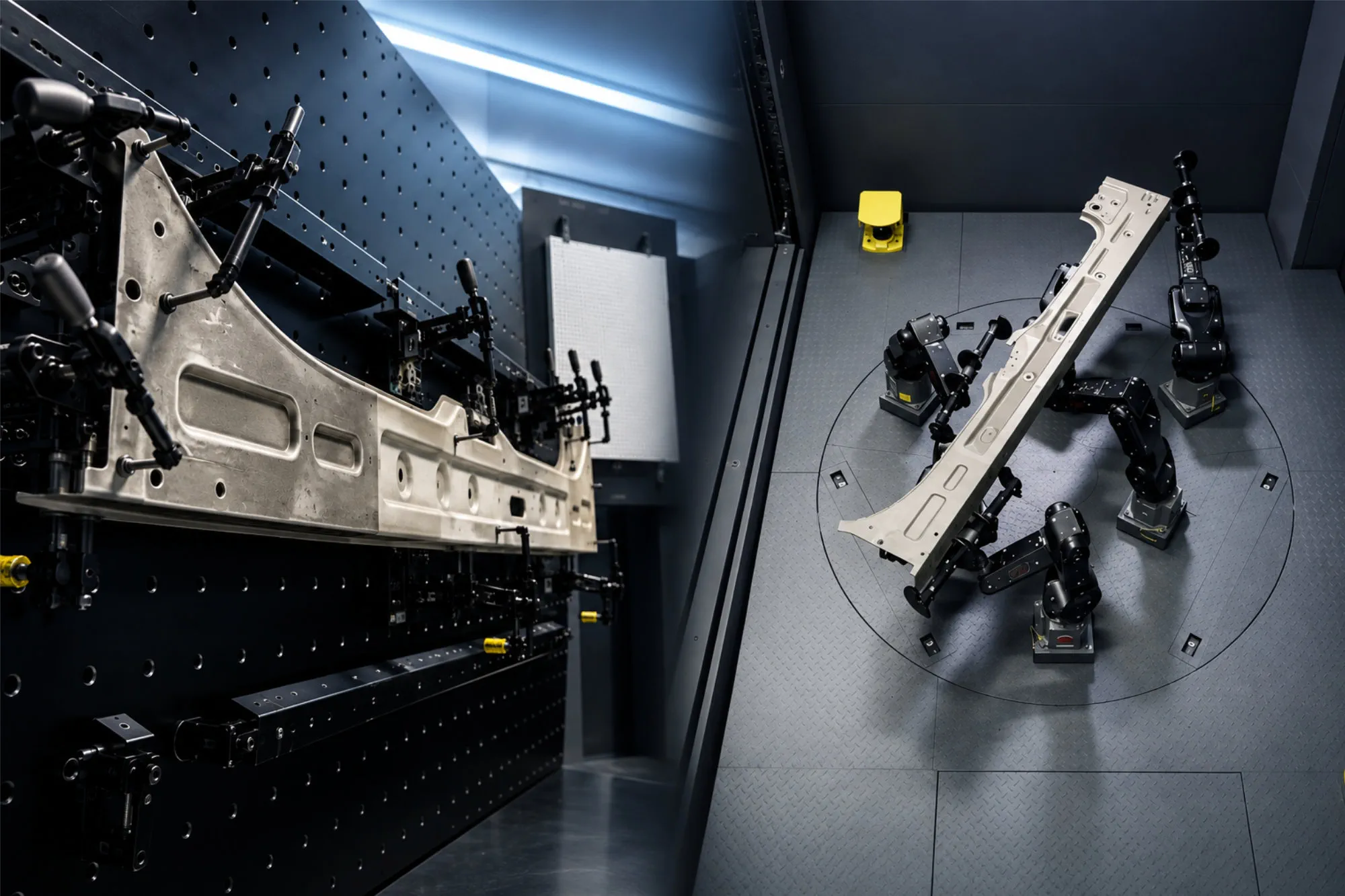
New Requirements for Fixtures in Automated 3D metrology
Automated measurement processes place high demands on component fixturing. It must position components securely, create reproducible measurement conditions, and at the same time provide the best possible access for optical detection. Traditional, component-specific fixtures have reliably fulfilled this task for many years. However, as the variety of variants increases, product cycles shorten, and changes become more frequent, the demands for flexibility and adaptability are also growing.
Modular and digitally planable mounting concepts open up new possibilities here—including systems such as PRAFS, in which component mounting can be taken into account as early as the planning stage of the measurement process.
Your Benefits with PROTOS-3D
Planning Equipment Concepts Safely—Drawing on Experience in Measurement Technology, Sampling, and Automation
We combine practical experience with traditional measuring equipment, our own automated measuring systems, and the development of PRAFS to provide a comprehensive view of the entire measurement process.
Experience with conventional fixtures and sampling
Practical experience ranging from component-specific measurement to initial sample inspection and automated component testing.
PRAFS developed in-house
We develop PRAFS ourselves and understand the practical requirements for flexible, reusable mounting solutions.
In-house measurement systems for development and testing
Concepts can be planned, tested, and refined under real-world conditions in our automated testing environments.
Measurement expertise for the entire process
Component layout, accessibility, robot motion, measurement strategy, and evaluation are coordinated with one another.
Why Requirements Change
Modern quality processes today are shaped by several trends: more variants, shorter product cycles, automated measuring cells, and the need to use existing equipment as efficiently as possible. This increases the workload when a completely separate fixture must be designed, manufactured, stored, and later retrieved for each new application.
Therefore, there is a need for designs that not only function mechanically but can also be adapted more quickly to new components and measurement tasks.
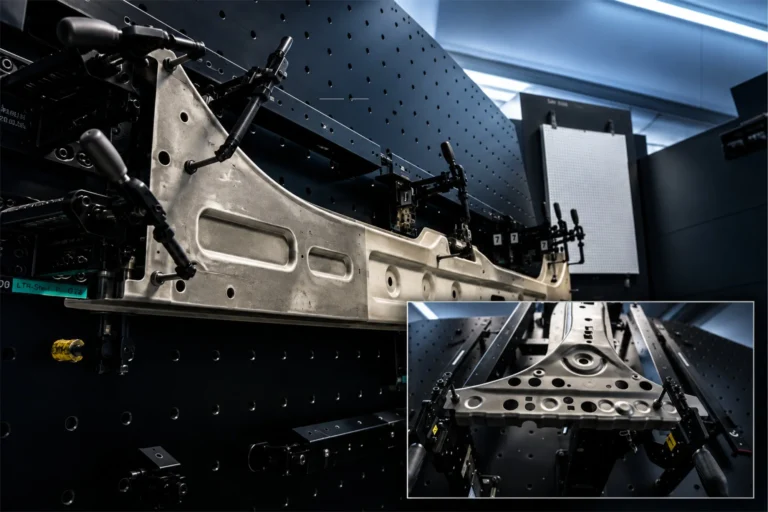
Traditional Devices—Tried, Tested, and Reliable
Despite increasing demands for flexibility and a wide range of variants, traditional, component-specific measuring fixtures still have their place. They are designed specifically for a particular component or a defined family of components, offer high repeatability, and can be precisely adjusted to clamping and support points. This approach remains particularly useful for components that remain unchanged over the long term and for high repeat counts.
However, as the variety of options increases, new challenges arise:
- Additional fixtures are required for different components.
- Design and manufacturing lead times must be reassessed whenever changes are made.
- Storage and staging areas increase as the number of devices grows.
- Changeovers and model changes result in additional setup times.
- Changes to the component may require modifications or a redesign.
The device is thus increasingly becoming an integral part of process planning.
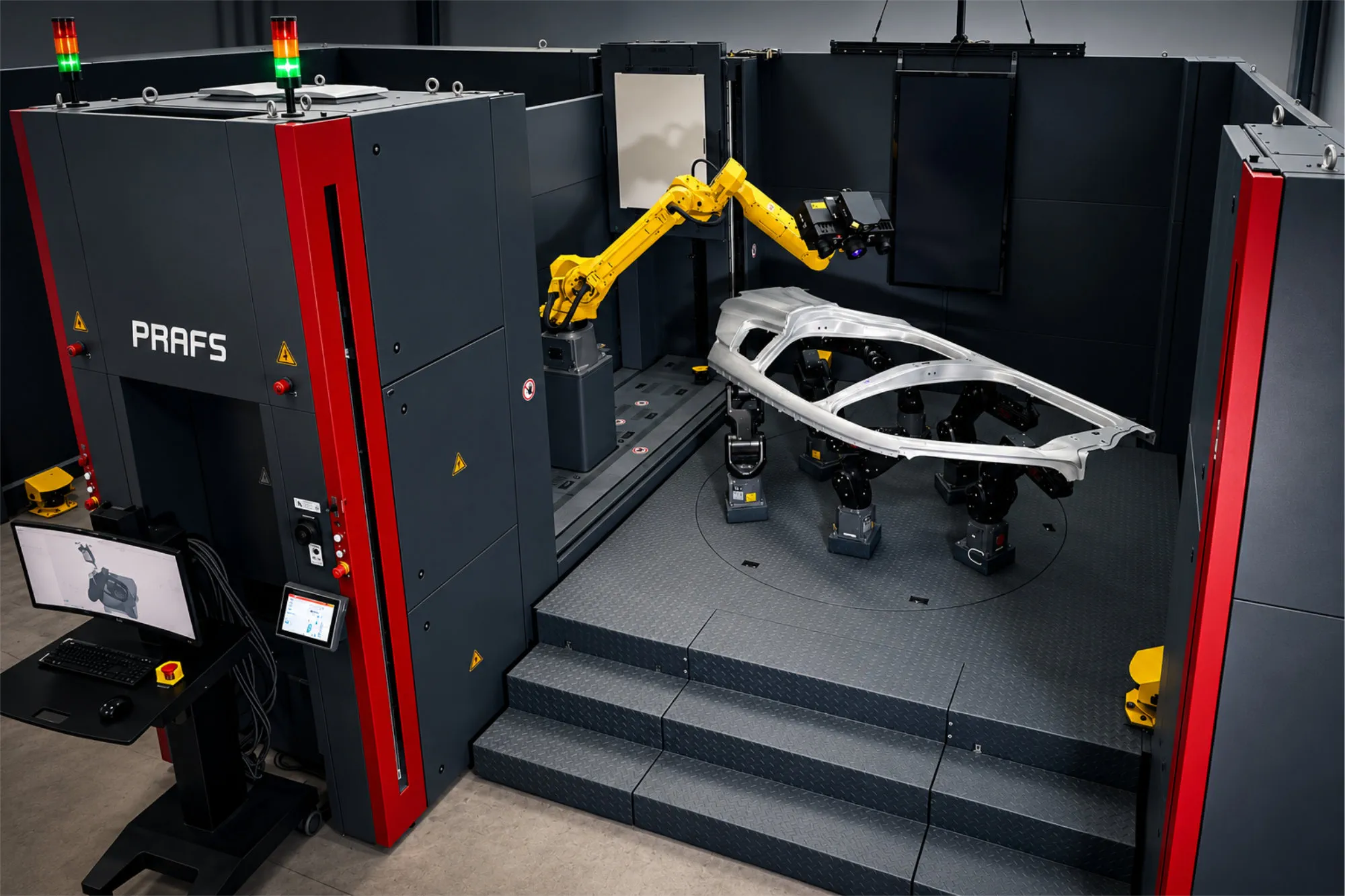
PRAFS - Component handling as part of automation
PRAFS It comes into play where interchangeable components, automated measurement processes, and the most flexible use of the system possible converge. The clamping system developed by PROTOS-3D uses flexibly positionable clamping elements instead of a fixture that is entirely specific to a particular component.
The positions are defined to suit the component and the measurement process and can be set up again in a reproducible manner. This allows the mounting concept to be reused for new variants and projects without having to completely rebuild the component mounting each time.
Development at a Glance
01
Classic
component-specific
02
Modular
reusable
03
Flexible
customizable
04
Planned Digitally
taken into account virtually
05
Automated
Integrated into the measurement process
Reusable
A mounting system can be reconfigured for different components and projects.
Reproducible
Defined positions of the mounting elements allow for a clear and repeatable assembly process.
Process-Integrated
Component mounting, accessibility, and the automated measurement process are considered a single, integrated process.
The benefits do not stem solely from the adjustable mechanism. A stable and repeatable component fixture forms the foundation; during digital planning, accessibility, sensor positions, robot movements, and potential collision zones are tailored to this real-world setup. As a result, the component fixture becomes a predictable component of the automated measurement process, and the need for adjustments to the actual system can be minimized.
Which solution is right for which application?
There is no single optimal device for every measurement process. The key factors are component variety, frequency of changes, production volume, degree of automation, and the planned service life.
Concept
Character
Particularly suitable for
Please note
Classic
Defined on a component-specific and permanent basis
Stable processes, consistent components, high repeatability
Limited flexibility regarding variants and changes
Modular
Reusable basic elements and adjustable components
Different components and applications with similar requirements
The effort involved in preparation and documentation remains significant
Digitally Integrated
Flexible data collection is already taken into account in the measurement planning
Wide variety of variants, automated measuring cells, frequent changes
Requires coordinated digital planning and process expertise
Taking a Holistic View of Equipment Designs
The appropriate component holder does not depend solely on its mechanical design. The key factor is how well it suits the variety of variants, production volume, degree of automation, and the planned measurement process.
Traditional setups remain a reliable solution for stable, repetitive processes. Flexible and digitally integrated concepts are becoming increasingly important in situations where applications change frequently and existing measurement capabilities need to be used efficiently.
PROTOS-3D In doing so, it combines experience in prototyping and traditional fixture engineering with its own hands-on experience with equipment, metrological expertise, and the development of PRAFS.
Rethinking Component Mounting
Would you like to make your automated measurement processes more flexible, or determine whether a variable part-holding concept is suitable for your application? We can help you evaluate part-holding methods, measurement strategies, and digital process planning—from the initial idea through implementation in the ScanBox.