
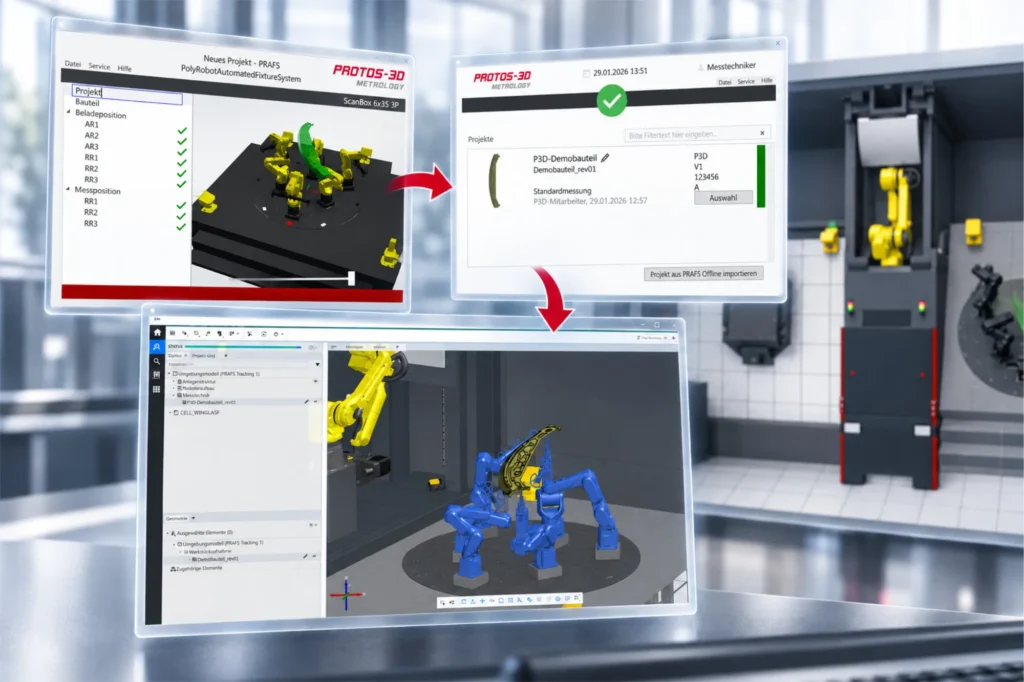
An " PRAFS" project is created through several digital steps
A PRAFSproject is prepared offline before deployment on the actual system. ZEISS software and EMUSIM work together in this process: In ZEISS, the component layout is defined in the virtual “ measurement room ,” while in EMUSIM, the “ PRAFS ” setup and the corresponding robot movements are planned. The prepared setup is then incorporated into the measurement programming and validated on the actual system.
This creates a common digital foundation for component handling, robotics, and the measurement process. The goal is not to redevelop every step of the system from scratch, but rather to verify key constraints early on and reduce the effort required for commissioning later on.
01
ZEISS VMR
Position a component
02
PRAFS Export
Transfer Data
03
EMUSIM
Planning Robot Paths
04
ZEISS
Prepare the measurement program
05
PRAFS HMI
Validation
Your Benefits with PROTOS-3D
PRAFS-Planning Projects Safely—Drawing on Experience in Measurement Technology and Automation
As the developers of PRAFS , we integrate robotics, component handling, and measurement technology into a seamless end-to-end process.
Expertise straight from the developers of " PRAFS"
Practical knowledge in measurement technology, robotics, and automation.
An Overview of the Entire Measurement Process
Component layout, accessibility, and robot positioning are considered together.
Less work on the actual system
Many issues can already be resolved digitally.
Personalized Technical Support
Direct support from planning through implementation.
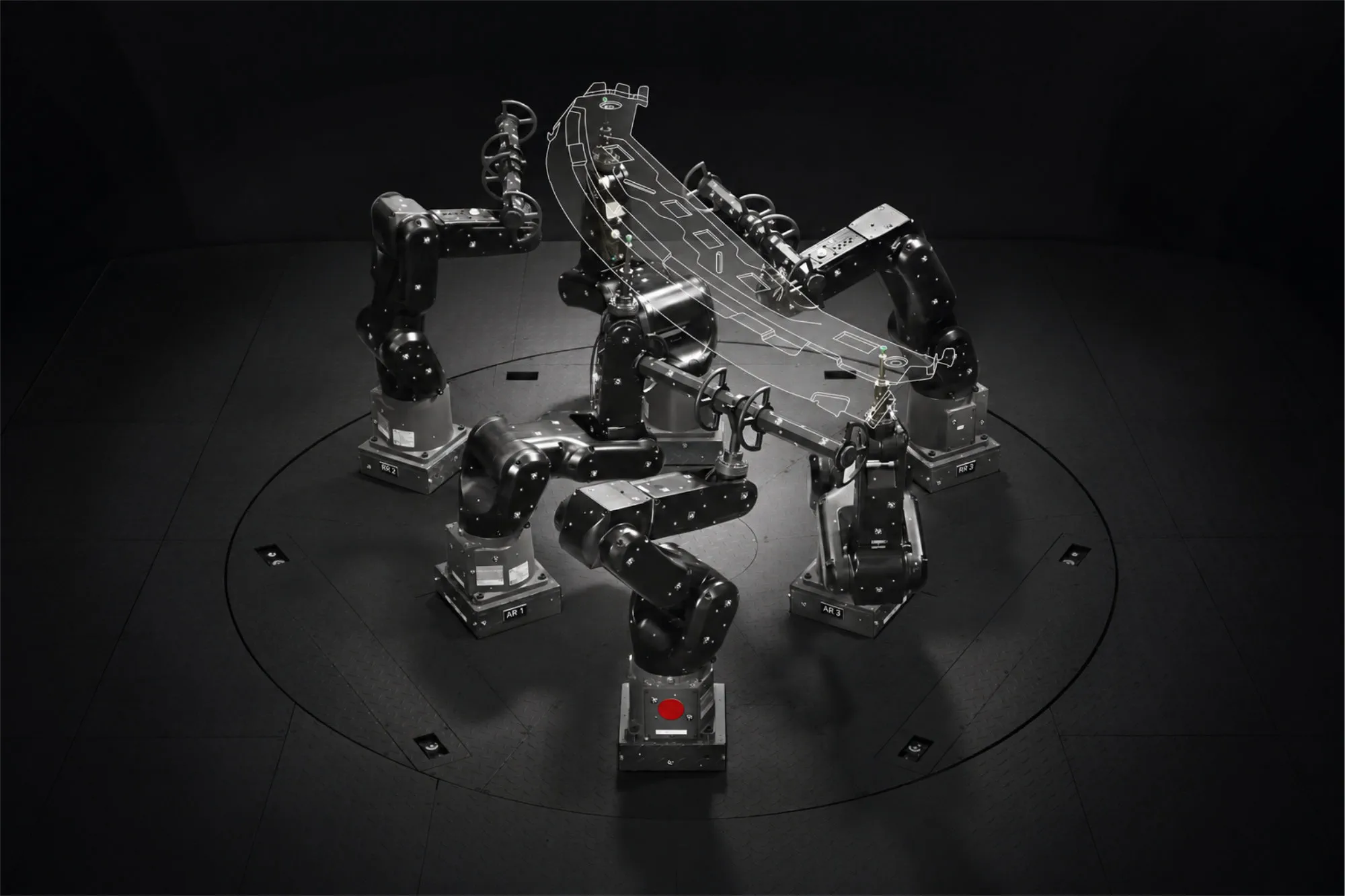
The component is first defined in the virtual measurement room
The first step is to select the appropriate component in the virtual measurement room. This process takes into account which PRAFS– and ScanBox configuration is available and how the component is generally intended to be mounted.
The CAD model is positioned in the ZEISS Software's " PRAFS" (VMR ). It is crucial to position the model in a way that allows for stable mounting and ensures that the areas relevant for subsequent measurement remain as accessible as possible.
This establishes a key part of the measurement strategy even at this early stage: component orientation, available contact areas, and measurement accessibility are all considered together before the actual robot planning begins.
Set the configuration
PRAFS- The " ScanBox" configuration provides the framework for further planning.
Print Runs
The components are selected to ensure a stable and reproducible mounting.
Component Orientation
The orientation of the component is selected to match its geometry and the subsequent measurement procedure.
Measurement accessibility
Relevant surfaces should remain as accessible as possible for the sensor and the measurement process.
The handoff point between ZEISS and EMUSIM
Once the component has been specified, the necessary information is transferred from the ZEISS environment to EMUSIM. The robot planning performed there is thus based on the same geometric foundation that was previously defined in the virtual measurement room .
This data exchange links the two design steps: The component position does not need to be recreated in EMUSIM, but can be used directly for the further design of the PRAFS mount.
Why This Step Is Important
ZEISS and EMUSIM work with the same defined part data. This ensures that the geometric foundation is maintained throughout the entire digital project workflow.
01
Schedule a recording
Contact areas and robot positions are determined based on the part geometry and the intended mounting.
02
Loading & Measuring
The positions for the loading and measurement phases are coordinated in such a way as to ensure a clear and reproducible sequence of operations.
03
Check Movements
Robot paths are virtually evaluated for accessibility, range of motion, and potential collisions, and optimized as needed.
The specific robots and positions required depend on the particular PRAFS variant and configuration. For the project workflow, it is particularly important that mounting, referencing, and measurement accessibility be viewed as a single, integrated process.
Assess Movement Patterns in Advance
EMUSIM calculates the corresponding robot movements for the planned positions. This makes it possible to assess reachability, movement spaces, and potential collisions within the virtual environment and to optimize them as needed.
The result is a digitally prepared PRAFSlayout that describes the essential robot positions and movements for later use. Detailed fine-tuning is then carried out in conjunction with a measurement program and the actual system.
PRAFS-The setup and measurement program are coordinated with each other
After robot planning, the prepared " PRAFS" setup is merged back into the ZEISS environment. This allows the planned robot positions and the available measurement accessibility to be taken into account when creating the measurement program.
PRAFS-Project
The planned robot workflow is made available for later use on PRAFS .
ZEISS Measurement Project
The prepared setup is taken into account during measurement programming to ensure that the measurement strategy aligns with the actual layout.
The measurement program is therefore not developed in isolation from the component mounting. Sensor positions, measurement ranges, and the actual spatial configuration are tailored to the intended PRAFS setup.
PRAFS's program and ZEISS's measurement program are thus digitally integrated before the entire process is tested for the first time on the actual system.
Planned digitally—tested in real life
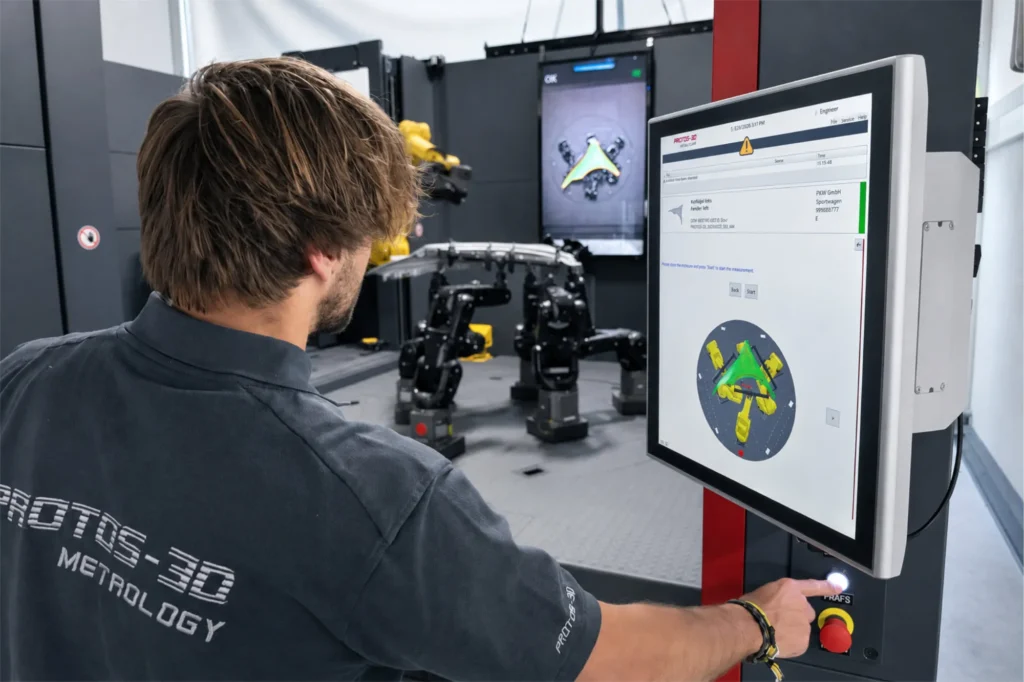
Offline programming provides a solid foundation, but it does not replace the final test on the actual system. During a controlled commissioning process, the planned positions and motion sequences are verified under real-world conditions and fine-tuned as needed.
Only after this validation is the PRAFS setup approved for regular operation. This allows a large portion of the planning to be completed in advance, while the final validation takes place where the process will actually run later on.
Less on-site commissioning. Greater planning reliability before commissioning.
Frequently Asked Questions
Does programming for the " PRAFS" start directly in EMUSIM?
No. First, the component position is defined in the appropriate ZEISS software module " PRAFS" (VMR ). This position then serves as the basis for further robot planning in EMUSIM.
What exactly is programmed in EMUSIM?
In EMUSIM, the " PRAFS" recording and the required robot movements are prepared for the planned sequence. The positions required depend on the specific " PRAFS" and system configuration.
Why are the " PRAFS" structure and the ZEISS measurement program being combined again?
This ensures that the measurement strategy can be tailored to the actual planned component mounting. As a result, robotics, measurement accessibility, and sensor movements are not planned independently of one another.
Can the simulation completely rule out collisions?
No. Virtual planning helps identify problematic positions and potential collisions early on. However, the final validation is still performed on the actual PRAFS system.
Can existing PRAFS projects be modified?
Yes. Existing projects can be adapted to new component variants or changed system conditions. The affected areas are then re-checked and validated.
Offline programming combines data acquisition, robotics, and measurement processes
An " PRAFS" project arises from the interplay of component positioning, robot planning, and measurement programming. If these areas are already digitally coordinated, the subsequent process on the production line can be prepared more effectively.
Offline programming thus provides greater planning reliability, reduces the amount of fine-tuning required during commissioning, and offers a solid foundation for recurring or customized measurement tasks.